Healthcare is becoming increasingly connected through digital technology. Patients now expect easier ways to book appointments, communicate with healthcare providers, access health information, manage prescriptions, and monitor ongoing health conditions.
For healthcare businesses, hospitals, clinics, startups, and healthcare service providers, a mobile application can create a more convenient connection with patients while also improving internal workflows.
But developing a healthcare application is different from building a regular consumer app.
Healthcare applications may handle sensitive personal information, integrate with medical systems or wearable devices, support consultations, and require strong security measures. As a result, the development cost depends heavily on the application’s purpose, functionality, technology, integrations, and compliance requirements.
If you’re planning a healthcare product with a Mobile App Development Company in Chennai, this guide explains the major cost factors, essential features, development stages, and practical ways to plan your investment in 2026.
What Is a Healthcare App?
A healthcare application is a mobile or digital platform designed to support patients, healthcare professionals, clinics, hospitals, or other healthcare-related services.
Depending on the business model, an application may help users:
- Book medical appointments
- Consult healthcare professionals remotely
- Manage prescriptions
- Receive medication reminders
- Access medical reports
- Monitor health metrics
- Track fitness and wellness information
- Communicate with healthcare providers
- Manage ongoing health conditions
The functionality required depends entirely on the intended users and the healthcare problem the application is trying to solve.
A simple appointment application and a telemedicine platform with video consultations, payments, prescriptions, and patient records will have very different development requirements.
Why Are Healthcare Apps Becoming Important?
Healthcare services often involve multiple steps, appointments, documents, reminders, and communication between patients and providers.
A well-designed application can simplify some of these interactions.
For patients, an app can provide:
- Convenient appointment management
- Faster access to information
- Digital communication
- Reminders
- Easier access to selected health records
- Remote service options where appropriate
For healthcare organizations, applications can help improve operational efficiency and provide a more organized digital experience.
However, technology should support healthcare professionals and patients rather than replace professional medical judgement.
Types of Healthcare Apps Businesses Can Build
The type of application is one of the first factors that influences development costs.
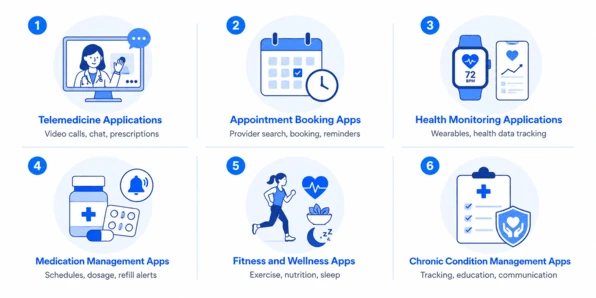
Telemedicine Applications
Telemedicine apps can connect patients with healthcare professionals through video, audio, or secure messaging.
Depending on the product, they may include:
- Doctor profiles
- Appointment scheduling
- Consultation management
- Video calls
- Chat
- Payments
- Digital prescriptions
- Notifications
The real-time communication infrastructure can increase development complexity.
Appointment Booking Apps
These applications focus primarily on helping patients discover providers and manage appointments.
Common features include:
- Provider profiles
- Availability
- Calendar management
- Booking
- Rescheduling
- Cancellation
- Reminders
Compared with a full telemedicine platform, the technical requirements may be simpler.
Health Monitoring Applications
Health monitoring apps can allow users to record or receive health-related information.
Depending on the use case, they may connect with wearable devices or other health-data sources.
The complexity increases when applications need to process continuous data or connect with multiple external devices.
Medication Management Apps
These applications can help users manage medication schedules through reminders and tracking.
Features may include:
- Medication schedules
- Reminder notifications
- Dosage information entered by users or professionals
- Medication history
- Refill reminders
The design should remain simple because users may include people who are not comfortable with complex technology.
Fitness and Wellness Apps
Fitness and wellness applications can focus on exercise, nutrition, activity tracking, sleep, or general lifestyle management.
These are generally different from clinical healthcare applications because the nature and sensitivity of the information can vary.
Chronic Condition Management Apps
Applications supporting long-term health management may provide tracking tools, reminders, educational information, and communication features.
Such products require particularly careful planning around data handling, user experience, and the boundaries of automated recommendations.
Must-Have Features in a Healthcare App
The feature list directly affects development costs.
1. User Registration and Profiles
Patients may need accounts containing basic information, preferences, appointments, and other relevant details.
Healthcare providers may require separate profiles with additional information.
If the application supports multiple user roles, authentication and access-control requirements become more complex.
2. Appointment Management
Appointment functionality may include:
- Available slots
- Booking
- Rescheduling
- Cancellation
- Calendar integration
- Reminders
The backend needs to keep availability synchronized to avoid conflicting bookings.
3. Secure Communication
Healthcare platforms may require communication between patients and providers through:
- Chat
- Voice
- Video
Real-time communication can increase both development and infrastructure requirements.
4. Digital Payments
If the application supports paid consultations or services, payment gateway integration may be required.
The development team also needs to consider payment status, failed transactions, refunds, receipts, and transaction records.
5. Notifications
Notifications can remind users about:
- Upcoming appointments
- Medication schedules
- Consultation updates
- Booking confirmations
- Important account activity
Notifications should be relevant and controlled because excessive alerts can negatively affect the user’s experience.
6. Health Data Integration
Depending on the application, integration with wearable devices or health platforms may be required.
The technical effort depends on the type of data, external platform, synchronization frequency, and business requirements.
7. Admin Dashboard
Healthcare organizations may need an administrative dashboard to manage:
- Users
- Providers
- Appointments
- Content
- Payments
- Reports
- Notifications
- A mobile application often requires a web-based administration system behind the scenes.
Security Should Be a Core Requirement
Healthcare applications can handle highly sensitive information.
That makes security one of the most important development considerations.
Depending on the application’s market and functionality, the team may need to address:
- Secure authentication
- Authorization
- Encryption
- Access controls
- Secure APIs
- Data storage
- Session management
- Audit requirements
- Third-party integrations
Regulatory and privacy requirements can also vary depending on the country, type of healthcare organization, and information being processed.
For this reason, healthcare businesses should discuss applicable regulatory requirements with qualified legal or compliance professionals alongside their technology team.
How AI Can Be Used in Healthcare Apps
AI is creating new possibilities for healthcare technology, but it needs to be implemented responsibly.
- Potential use cases include:
- Patient-support chat interfaces
- Appointment assistance
- Medical information search
- Administrative automation
- Data summarization
- Personalized wellness suggestions
- Pattern identification in approved use cases
However, AI-generated information should not automatically be treated as medical diagnosis or professional advice.
For healthcare products, the role of AI should be clearly defined, tested, monitored, and designed with appropriate human oversight.
This is particularly important when an application deals with sensitive health decisions.
UI/UX Design Matters More in Healthcare
Healthcare applications serve people of different ages, technical abilities, and levels of digital familiarity.
A confusing interface can create unnecessary stress.
Good UI/UX Design should focus on:
- Clear navigation
- Readable text
- Simple forms
- Accessible controls
- Clear appointment information
- Easy-to-understand notifications
- Consistent screen layouts
Important actions should not be hidden behind complicated menus.
For example, a patient should be able to quickly identify an upcoming appointment without navigating through several unrelated screens.
Healthcare App Development Process
A professional development process usually involves several stages.
1. Requirement Discovery
The business objectives, users, workflows, integrations, and technical requirements are documented.
2. Market and Competitor Research
The team studies existing healthcare products to identify user expectations and opportunities for differentiation.
3. Feature Prioritization
The essential features are separated from future enhancements.
This helps create a realistic first version.
4. UI/UX Design
User journeys, wireframes, prototypes, and visual designs are developed and reviewed.
5. Backend and Mobile Development
The frontend application, backend systems, APIs, databases, authentication, and required integrations are developed.
6. Testing
The product is tested for functionality, usability, security, performance, compatibility, and other relevant requirements.
7. Deployment
The application is prepared for the appropriate production environment and app distribution platforms.
8. Continuous Improvement
After launching, user feedback, analytics, technical performance, and business requirements can guide future updates.
How Much Does Healthcare App Development Cost in 2026?
There is no fixed price for healthcare app development.
As a general planning reference:
| Healthcare App Type | Approximate Development Cost |
|---|---|
| Basic Healthcare App | $10,000 – $20,000 |
| Medium-Complexity Healthcare App | $20,000 – $50,000 |
| Advanced Telemedicine / Health Platform | $50,000 – $100,000+ |
| Complex Healthcare Ecosystem | $100,000+ |
These are indicative ranges, not fixed quotations.
The actual cost can vary significantly depending on the number of platforms, design requirements, backend architecture, integrations, security requirements, third-party services, and development teams.
For an India-based development project, the final budget can also differ considerably based on the selected team and project scope.
Major Factors That Influence Healthcare App Development Cost
App Complexity
An application with appointment booking is considerably different from a platform supporting telemedicine, payments, health data, and multiple user roles.
More functionality generally means more development and testing effort.
Number of Platforms
Developing for Android, iOS, or both affects the development strategy and budget.
Cross-platform technologies may help reduce duplicated development work for suitable projects, but the decision should be based on technical requirements.
UI/UX Requirements
Custom designs, prototypes, accessibility requirements, animations, and complex user journeys can increase design effort.
Backend Architecture
A healthcare application may require APIs, databases, cloud infrastructure, authentication, dashboards, and multiple integrations.
These backend requirements can represent a significant portion of the project.
Third-Party Integrations
Integrating payment gateways, video services, wearable platforms, healthcare systems, notification services, or other external APIs can increase development complexity.
Security and Compliance Requirements
Healthcare products may require additional technical, legal, and compliance considerations depending on the market and use case.
Maintenance
The cost does not end when the app is published.
Businesses should budget for:
- Bug fixes
- Security updates
- Operating-system updates
- Server costs
- API charges
- Performance optimization
- New features
- Monitoring
How to Control Healthcare App Development Costs
Reducing costs does not mean removing important quality or security requirements.
Instead, businesses can make smarter planning decisions.
Start With a Focused MVP
Launch the smallest version that can deliver the application’s core value.
Prioritize Features
Separate essential functionality from features that can be introduced later.
Reuse Proven Components
Where appropriate, reliable third-party services and reusable components can reduce development time.
Choose Technology Carefully
Select the technology based on product requirements rather than trends.
Validate UX Before Development
Prototypes can identify usability problems before developers spend significant time implementing the final experience.
Avoid Unnecessary Complexity
A healthcare app should be as sophisticated as required but not more complicated than necessary.
Choosing the Right Development Partner
When looking for a Mobile App Development in Chennai for a healthcare product, businesses should evaluate more than development cost.
Consider:
- Healthcare-related project experience
- Mobile development expertise
- Backend capabilities
- UI/UX experience
- Security practices
- Testing methodology
- Integration experience
- Communication process
- Post-launch support
Ask potential development partners to explain how they would approach your specific product rather than providing only a generic quotation.
A team that understands your users and workflows can often identify technical challenges much earlier.
Healthcare Apps Need a Long-Term Product Strategy
Launching an app is only the first stage.
Once patients and healthcare professionals begin using it, businesses can learn from:
- User feedback
- App reviews
- Feature usage
- Support requests
- Conversion data
- Drop-off points
- Technical performance
This information can help determine which features should be improved or introduced next.
A healthcare product should evolve carefully based on real-world requirements.
Final Thoughts
The cost of developing a healthcare app in 2026 depends on much more than the number of screens.
The type of healthcare service, user roles, security requirements, integrations, platform strategy, UI/UX, backend architecture, AI functionality, testing, and long-term maintenance can all influence the final investment.
For businesses evaluating Mobile App Development Services in Chennai, the lowest quotation should not automatically be the deciding factor.
A better approach is to choose a development partner that understands the product, asks the right questions, plans security from the beginning, builds around real user needs, and provides a clear path for future improvements.
Healthcare technology should ultimately make healthcare experiences more accessible, organized, and convenient without compromising trust, privacy, or responsible use of technology.
Frequently Asked Questions
1. How much does it cost to develop a healthcare app in 2026?
A basic healthcare application may start around $10,000, while advanced telemedicine or healthcare platforms can exceed $50,000 or even $100,000 depending on functionality and integrations.
2. How long does healthcare app development take?
3. Can AI be integrated into a healthcare application?
4. Is healthcare app development more expensive than regular app development?
5. How can I reduce healthcare app development costs?
Start with an MVP, prioritize essential features, validate the UX early, use suitable third-party services, select technology carefully, and avoid unnecessary functionality during the first release.